How to evaluate strategic options
Good strategic choices come from testing real alternatives against the same criteria, in writing, before anyone commits. Here is a method a team can follow.
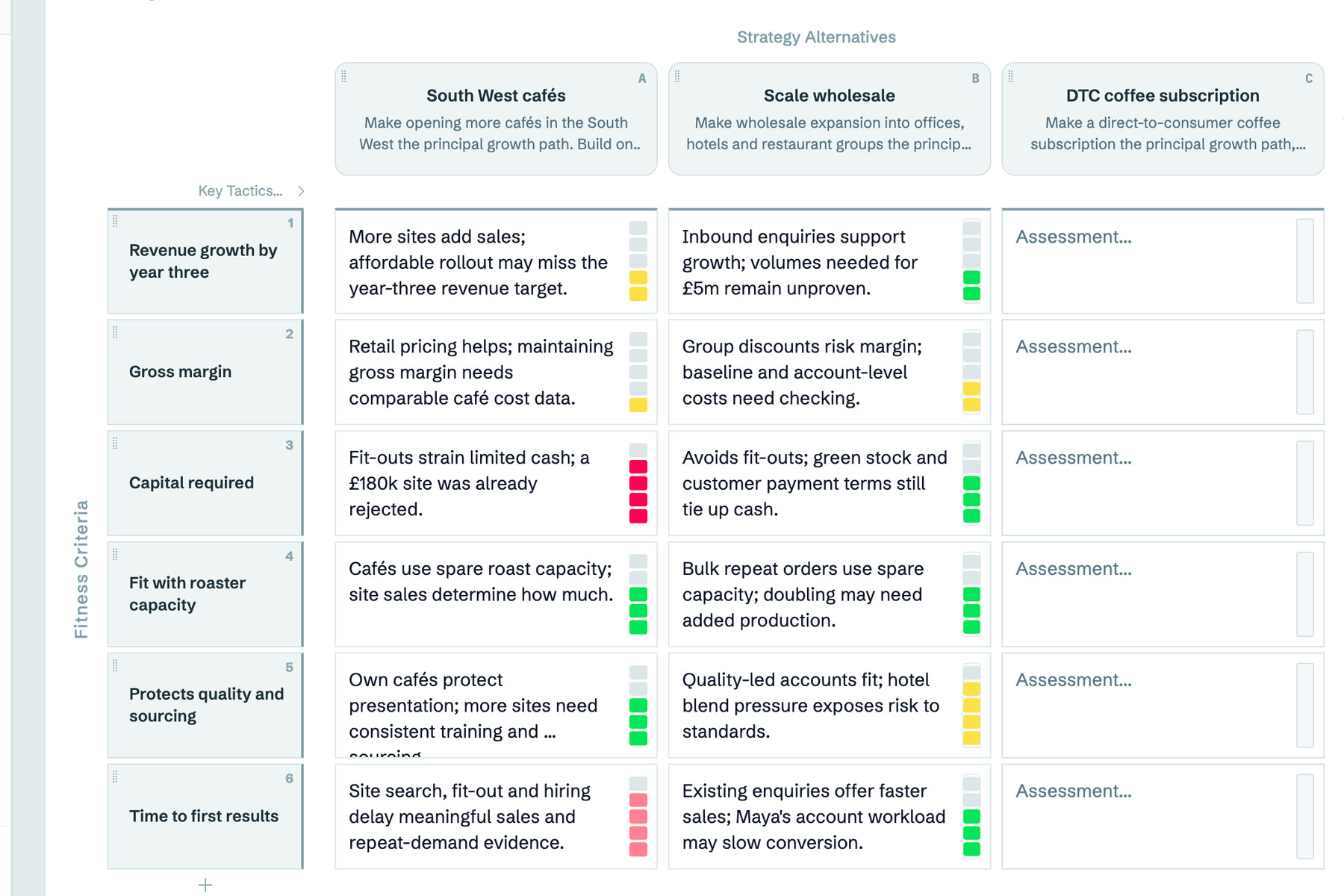
Start with real options
An evaluation can only choose among the options on the table. Before scoring anything, make sure there are at least three genuinely different ways forward, each one something a sensible person would argue for. Variations on one idea, such as the same expansion at three speeds, count as one option.
Options usually come from the diagnosis. Once you know what stands in the way, each alternative is a different answer to it. Strategic diagnosis covers that step. A SWOT analysis can supply options too, once its quadrants are paired, as From SWOT to strategy shows.
The classic criteria
Gerry Johnson and Kevan Scholes, in Exploring Corporate Strategy, test each strategic option with three questions:
- Suitability: does it address the situation, using the organisation's strengths against its real problems and opportunities?
- Acceptability: are the expected returns, the risk and the reaction of stakeholders acceptable?
- Feasibility: can the organisation actually do it, with the money, people and capabilities it has or can get?
Public bodies in the UK run the same exercise as an options appraisal, usually with a do-nothing option as the baseline.
Make the criteria specific
General criteria are a starting point. The decision gets easier when they become specific to the situation: the capital you can actually raise, the margin the business needs, the capacity you have spare, the time before results must show. The Emergent Approach calls these fitness criteria. Write each one so that a person could say whether an option meets it and why.
A method, step by step
- Write the aspiration and the diagnosis at the top of the page.
- List three to five alternatives as columns.
- List five to eight fitness criteria as rows.
- Assess every cell with a verdict and a sentence of reasoning.
- Rule out any option that fails a criterion it must meet.
- Compare the survivors on the criteria where they differ most.
- Choose, write down why, and record what would make you revisit the choice.
Laid out as a grid, this is a Strategy Alternatives Matrix.
Weighted scoring and its limits
A weighted decision matrix multiplies each score by the importance of its criterion and adds up the totals. It is quick and familiar. Its weakness for strategy is that a high score on one criterion can hide a failure on another, so an option the business cannot fund can still win on points. Ruling out failures first, then comparing what is left, closes that gap.
Common mistakes
- Deciding first and building the evaluation to support the answer.
- Assessing only the favourite option in depth.
- Scoring without writing down the reasons, so nobody can challenge them later.
- Treating the evaluation as final. Conditions change, and the reasons recorded for each verdict show which part of the decision a change affects.
Evaluating options in Wayframer
Wayframer lays every option out in the Strategy Alternatives Matrix. Huxley assesses each cell when you ask and records the reason, drawing on the files you allow, such as accounts or a capacity sheet. You decide which verdicts stand, rule out what cannot fit and lock the alternative left standing.
Related guides
The Strategy Alternatives Matrix. Set the ways forward side by side and test each against the same fitness criteria.
Strategic diagnosis. Say plainly what is in the way, and find the bottleneck that matters most.
How to write a strategy. What a written strategy needs, a strategy statement, and tests to run on the draft.
Questions
What are the criteria for evaluating strategic options?
The most widely taught are suitability, acceptability and feasibility, from Johnson and Scholes. They work best turned into specific fitness criteria for your situation, such as the capital required, the margin earned and the fit with your capacity.
What is an options appraisal?
A comparison of the possible ways of meeting an objective, usually including a do-nothing baseline, against agreed criteria, so the choice and its reasons are on record. It is standard practice in UK public bodies such as the NHS.
How many strategic options should you compare?
Three to five genuinely different options. Fewer gives no real choice, and more makes it hard to assess each one carefully.
Should you use a weighted decision matrix for strategy?
It helps with simple choices. For strategy, first rule out options that fail a criterion they must meet, because a weighted total can let an unfundable or unworkable option win on points.