Strategic diagnosis
A strategy is only as good as its account of the problem. A strategic diagnosis says what is really in the way, plainly enough that the right moves become clear.
What a strategic diagnosis is
A strategic diagnosis is a short explanation of the situation an organisation faces and the main thing holding it back. Richard Rumelt made it the first part of the kernel of good strategy in Good Strategy/Bad Strategy (2011): a diagnosis, a guiding policy that deals with it, and coherent actions that carry the policy out.
The diagnosis comes first because everything else depends on it. A team that misreads its problem can carry out its plan perfectly and still fail.
What good diagnoses have in common
- They are specific. A diagnosis that could describe any company in any industry says nothing.
- They name a cause. "Our best customers now buy direct from the manufacturers we resell" explains why sales are falling.
- They simplify. A diagnosis picks the few issues that matter most out of everything that could be said.
- They point somewhere. Once the diagnosis is written, some actions plainly make sense and others plainly do not.
Find the bottleneck
Eliyahu Goldratt's theory of constraints, set out in The Goal (1984), holds that every system has a constraint that limits what it can produce, and improving anything else changes little. Strategy behaves the same way. The Emergent Approach asks a team to name the bottleneck: the one thing that most limits progress towards its aspiration. Richard Rumelt's endorsement of Peter Compo's book singles out how it helps readers identify "killer problems" and critical "bottlenecks".
A bottleneck might be cash, capacity, a missing skill, a regulation, a customer habit or a decision nobody is willing to make. Naming it focuses every alternative on the same question: how do we get past this?
How to write one
- Write down the aspiration, so it is clear what progress means.
- Gather the evidence: the numbers, what customers say, what has been tried and how it went.
- List everything that seems to be in the way, then ask which items cause the others.
- Choose the bottleneck, and write two or three sentences on why it is the one.
- Test it. If this were solved, would progress follow? If the answer is no, keep looking.
Examples
Weak: "The market is challenging and competition is increasing." This is true of every market, so it helps no one choose.
Stronger: "Demand for our wholesale coffee is rising faster than we can fund green stock, because customers pay at sixty days and our suppliers want payment at thirty. Working capital is what limits our growth." This names a cause, and it already suggests which alternatives deserve a look.
Diagnosis in Wayframer
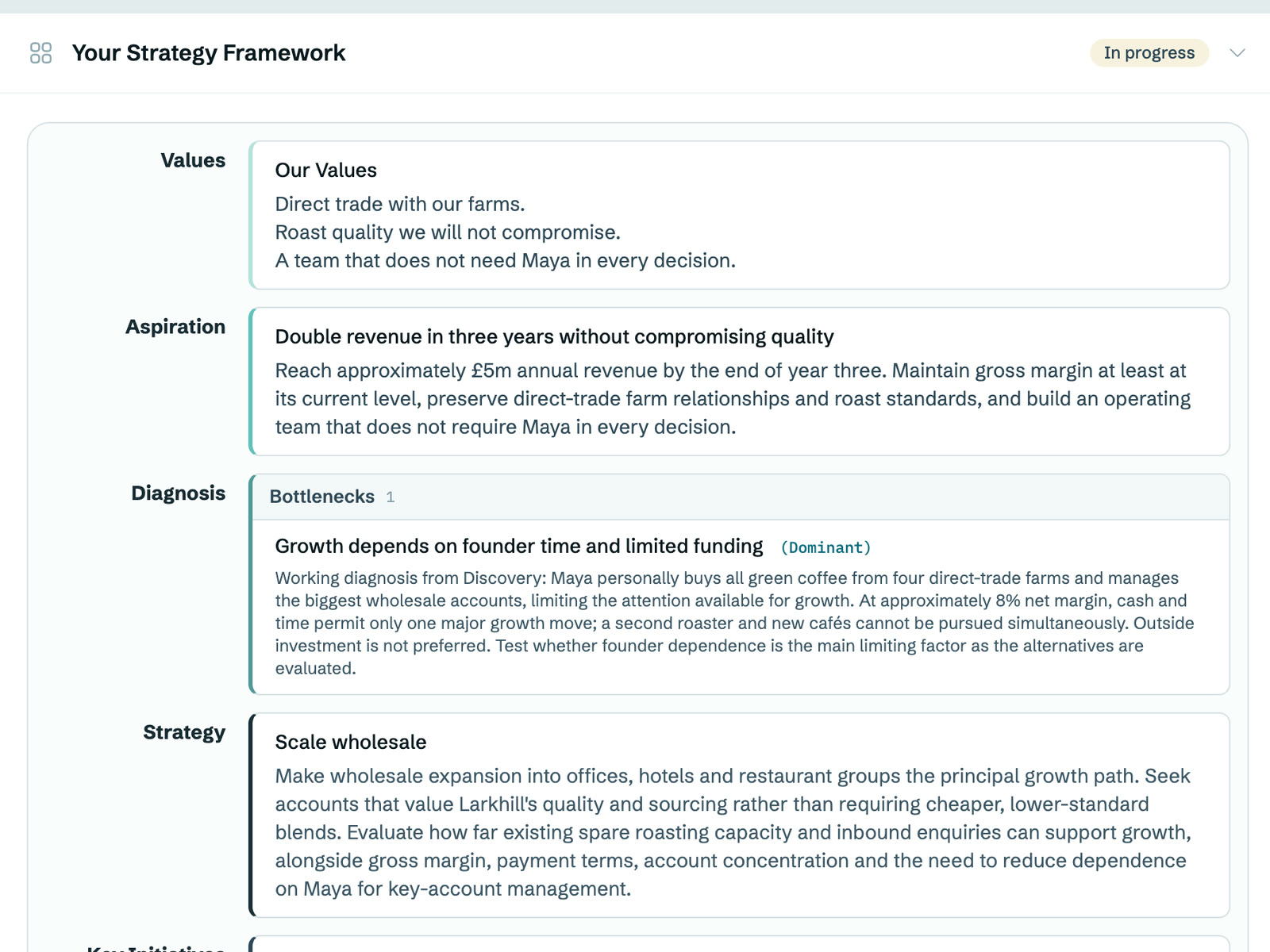
Every strategy framework in Wayframer has a Diagnosis section beside its values, aspiration and strategy alternatives. Huxley can draft it from the discovery conversation and from files you allow, such as management accounts, and the likely bottleneck appears on the cover of the Implementation Pack. Because the alternatives sit in the same workspace, each one is judged against the problem the diagnosis describes.
Related guides
How to evaluate strategic options. Criteria and a step-by-step method for comparing ways forward and choosing one.
How to write a strategy. What a written strategy needs, a strategy statement, and tests to run on the draft.
Emergent strategy. What Henry Mintzberg meant, and how deliberate and emergent strategy fit together.
Questions
What is a strategic diagnosis?
A short explanation of the situation an organisation faces and the main thing holding it back. It is the first part of a strategy, and the alternatives and actions follow from it.
What is the kernel of good strategy?
Richard Rumelt's three-part core of any good strategy: a diagnosis of the challenge, a guiding policy for dealing with it, and coherent actions that carry the policy out.
What is a strategic bottleneck?
The single constraint that most limits an organisation's progress towards its aspiration. Naming it focuses every strategy alternative on getting past it. Purchasing teams use the word differently, for supplies that are hard to source.
How long should a strategic diagnosis be?
A few sentences to a page. It should be short enough that everyone involved can remember it, and specific enough that it could only describe your organisation.