How to write a strategy
A written strategy should let someone who was not in the room understand what you chose, why, and what you will do about it. Here is how to write one.
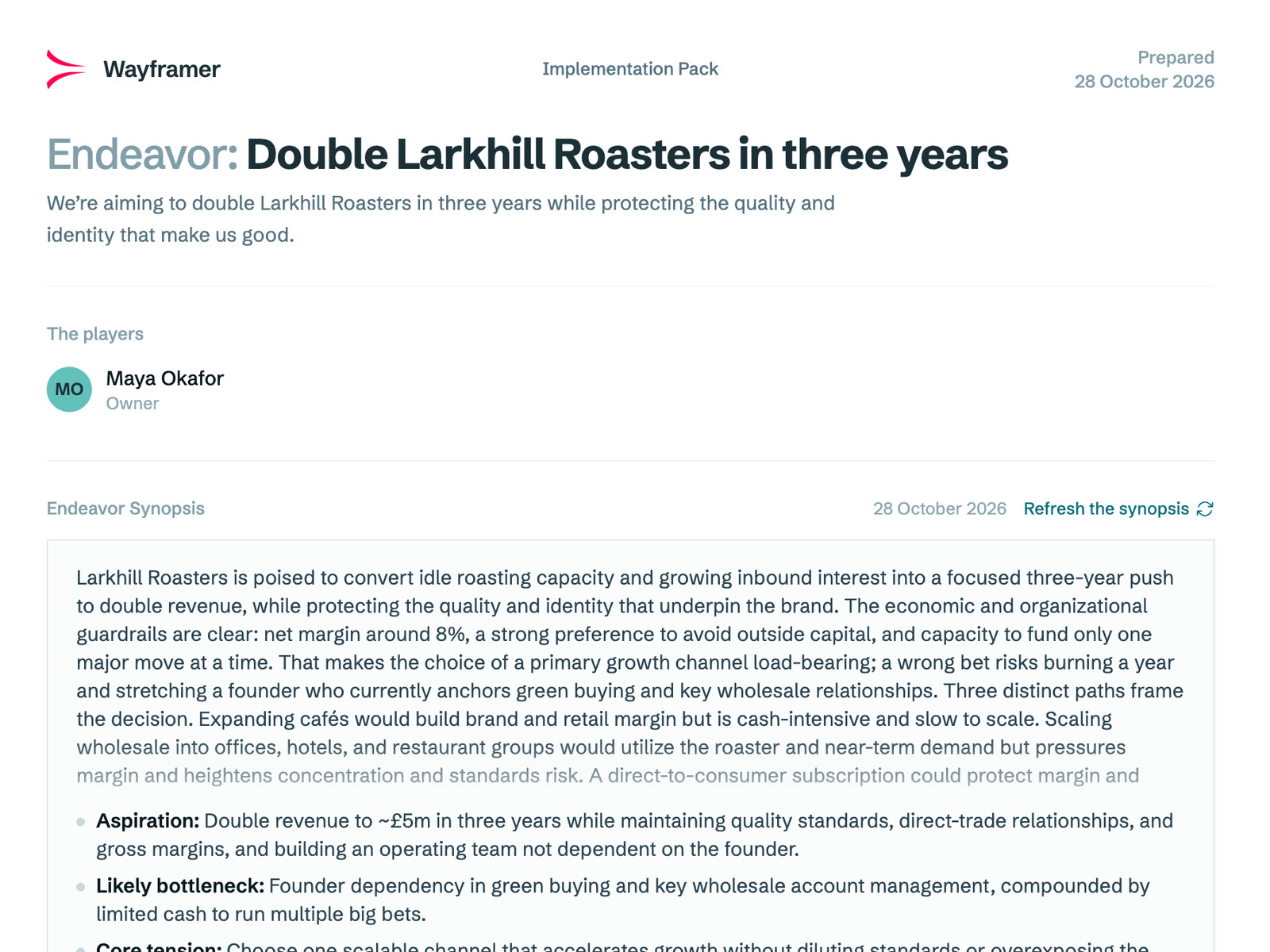
What a written strategy needs
A useful written strategy covers five things:
- The aspiration: where you want to be, specifically enough to know when you are there.
- The diagnosis: what stands in the way, and the bottleneck that matters most.
- The alternatives: the different ways forward you considered.
- The choice: the alternative you chose, and why the others were ruled out.
- The work: the initiatives that carry it out, with owners.
Write the strategy statement
Then boil the choice down to a strategy statement of two or three sentences. A common structure names the objective, the scope and the advantage: what you aim to achieve, where you will compete, and why you will win there. In Playing to Win (2013), A.G. Lafley and Roger Martin frame the same idea as a set of linked choices, starting with where to play and how to win.
Here is an example for a fictional coffee roaster: "Larkhill Roasters will double revenue in three years by scaling wholesale to independent cafés and restaurants. We will win on freshness and service from our own roastery, using capacity we already have, and will open no new cafés of our own in this period."
Tests for a written strategy
- Could a competitor write the same strategy? If so, it is too general.
- Does it rule anything out? A strategy that excludes nothing has made no choice.
- Does the diagnosis explain why this alternative won?
- Could someone who was not in the room explain it back to you?
- Does it say what would make you change course?
Keep it short, and keep it current
A strategy people read fits on a few pages, with the detail in appendices. Keep it where the team works, update it when the diagnosis changes, and date each version so everyone knows which reasoning is current.
Writing a strategy in Wayframer
Wayframer builds the document as you work. The workspace holds the values, aspiration, diagnosis and alternatives. Huxley drafts the parts you ask for and asks before replacing anything you wrote. Locking the strategy produces the Implementation Pack, with the endeavor and its synopsis, the strategy framework, the alternatives and the work that delivers it, ready to export as a PDF.
Related guides
Strategic diagnosis. Say plainly what is in the way, and find the bottleneck that matters most.
OKRs and strategy. Why the strategy comes first, and how to write OKRs that serve it.
Strategy implementation plan. What to put in the plan that turns a chosen strategy into work.
Questions
How do you write a strategy statement?
In two or three sentences, state the objective, the scope (where you will compete) and the advantage that will let you win there. Test it by asking whether a competitor could say the same.
How long should a strategy document be?
Short enough to read in one sitting, usually a few pages, with supporting analysis in appendices. The strategy statement itself fits in a paragraph.
What is the difference between a strategy and a goal?
A goal is what you want to achieve. A strategy is how you will achieve it, chosen from real alternatives because of what stands in the way.
What makes a strategy bad?
Richard Rumelt names four hallmarks in Good Strategy/Bad Strategy: fluff, failure to face the challenge, mistaking goals for strategy, and bad strategic objectives.