OKRs and strategy
OKRs are a good way to track progress on a strategy. They work best when the strategy is chosen first, on purpose, and the OKRs are written to serve it.
What OKRs are
Objectives and key results is a goal-setting system that Andy Grove developed at Intel and John Doerr brought to Google in 1999. An objective says what you want to achieve. Key results say how you will measure that you got there. Teams usually set them every quarter.
Where strategy comes in
A strategy is a choice about how to reach an aspiration, made because of a diagnosis of what stands in the way. OKRs describe targets. Two companies can share the objective of leading their market and pursue it with completely different strategies. Choosing between those strategies is work that OKRs leave to someone else.
Jeff Gothelf and Roger Martin have both written about OKRs standing in for strategy. When that happens, each team sets objectives that make sense locally and the organisation pulls in several directions at once.
Which comes first
Strategy comes first. Set the aspiration, diagnose what is in the way, choose the strategy, then write OKRs that track whether it is working. The key results become evidence about the strategy as well as targets for the team.
Writing OKRs from a strategy
- Take each initiative in the strategy's implementation plan.
- Write one objective for what the initiative should achieve this quarter.
- Write two to four key results that would show it is working.
- Add one key result that tests the strategy's main assumption, such as the demand it depends on.
Signs your OKRs have replaced your strategy
- Nobody can say which alternatives were considered, or why the current direction won.
- Objectives restate ambitions such as growth or leadership with no account of how.
- Teams' OKRs conflict, and there is no strategy to settle the conflict.
- A missed key result leads to a new target, and nobody asks whether the strategy is wrong.
Using OKRs with Wayframer
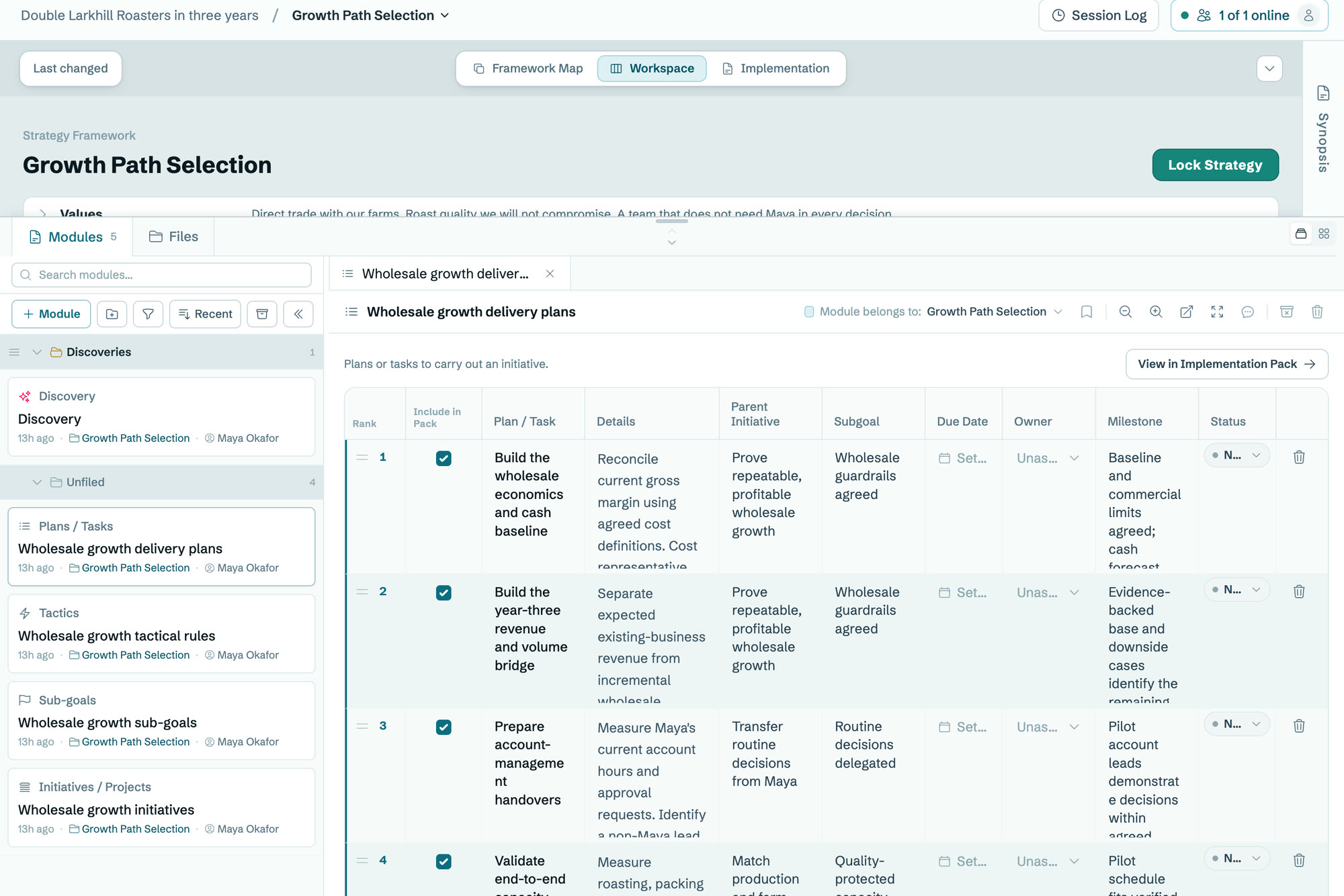
Wayframer is where the strategy is chosen: the aspiration, the diagnosis and the alternatives tested until one is left standing. The initiatives, sub-goals, plans and tactics that deliver it live in modules beside the strategy and travel into the Implementation Pack. Teams that already run OKRs can write them from those initiatives, so each key result traces back to the strategy it serves.
Related guides
Strategy implementation plan. What to put in the plan that turns a chosen strategy into work.
How to write a strategy. What a written strategy needs, a strategy statement, and tests to run on the draft.
The strategic planning process. Seven steps from a goal to a strategy the team can test and keep using.
Questions
Are OKRs a strategy?
No. OKRs set and measure goals. A strategy is the choice of how to reach them, based on a diagnosis of what stands in the way. OKRs work best written from a strategy that already exists.
What comes first, strategy or OKRs?
Strategy. Choose how you will reach your aspiration, then use OKRs to track whether that choice is working.
What is an alternative to OKRs?
Many teams keep OKRs and add the missing strategy layer above them. Others track a few measures for each initiative in their implementation plan. The right fit depends on how many teams need to coordinate.
How do OKRs relate to KPIs?
KPIs are ongoing measures of the health of the business. OKRs are time-bound targets for change. A key result often aims to move a KPI.