About Wayframer
Wayframer is where teams work out their strategy with the Emergent Approach, the method Peter Compo set out in his book.
Peter Compo
Peter wrote The Emergent Approach to Strategy and is the person behind Wayframer.
He spent twenty-five years at DuPont, moving through research, operations, marketing, product management and DuPont Ventures before he became director of corporate integrated business planning. He trained as a scientist, with a PhD in chemical engineering, and comes from a family of musicians.
Across science, music and business he kept seeing the same adaptive patterns. He left DuPont to turn them into a working theory of strategy, grounded in how complex adaptive systems behave. Wayframer brings that theory to the teams who have to use it.

The book
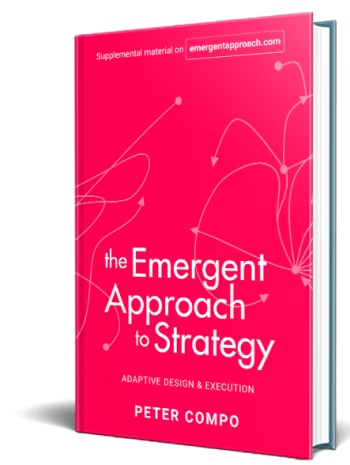
The Emergent Approach to Strategy: Adaptive Design and Execution was published by Business Expert Press in 2022.
It treats an organisation as a complex adaptive system, where strategy forms as people act and learn. It gives teams a shared language for that work: the bottleneck that blocks progress, the aspiration they are reaching for, and five tests a strategy has to pass, which Peter calls the Disqualifiers.
The book's supplements, templates and strategy diagnosis tool are at emergentapproach.com.
What strategists say about the book
“...a wonderful rethinking of the language and logic of business strategy. Be prepared to learn how to identify “killer problems” and critical “bottlenecks” as well as how to see the “disqualifiers” implicit in too many statements of strategy. This is a necessary addition to a strategist’s bookshelf.”
“Peter Compo presents a different way of thinking in his book The Emergent Approach to Strategy. It’s the best book I’ve read on strategy. His starting point is that organizations are complex adaptive systems and strategy needs to emerge rather than be planned.”
“Compo has provided a path to move beyond the typical annual strategy plan that never gets adopted. With an approach that drives clarity in intent with adaptability to change conditions and opportunities.”
Why we built Wayframer
Wayframer is a strategic planning platform built for organisations that operate in genuine complexity. It is built on the Emergent Approach, a methodology that treats strategy as a living process. Experimentation and observation shape it over time.
Teams use Wayframer to map their strategies and surface what is blocking progress. The platform also tracks aspirations. It connects AI analysis to your actual strategic context so the thinking stays relevant as conditions change.
We built Wayframer because traditional strategy tools assume a level of predictability that most organisations do not have. The world changes faster than annual plans account for. Strategy tools should reflect that.
How a strategy takes shape
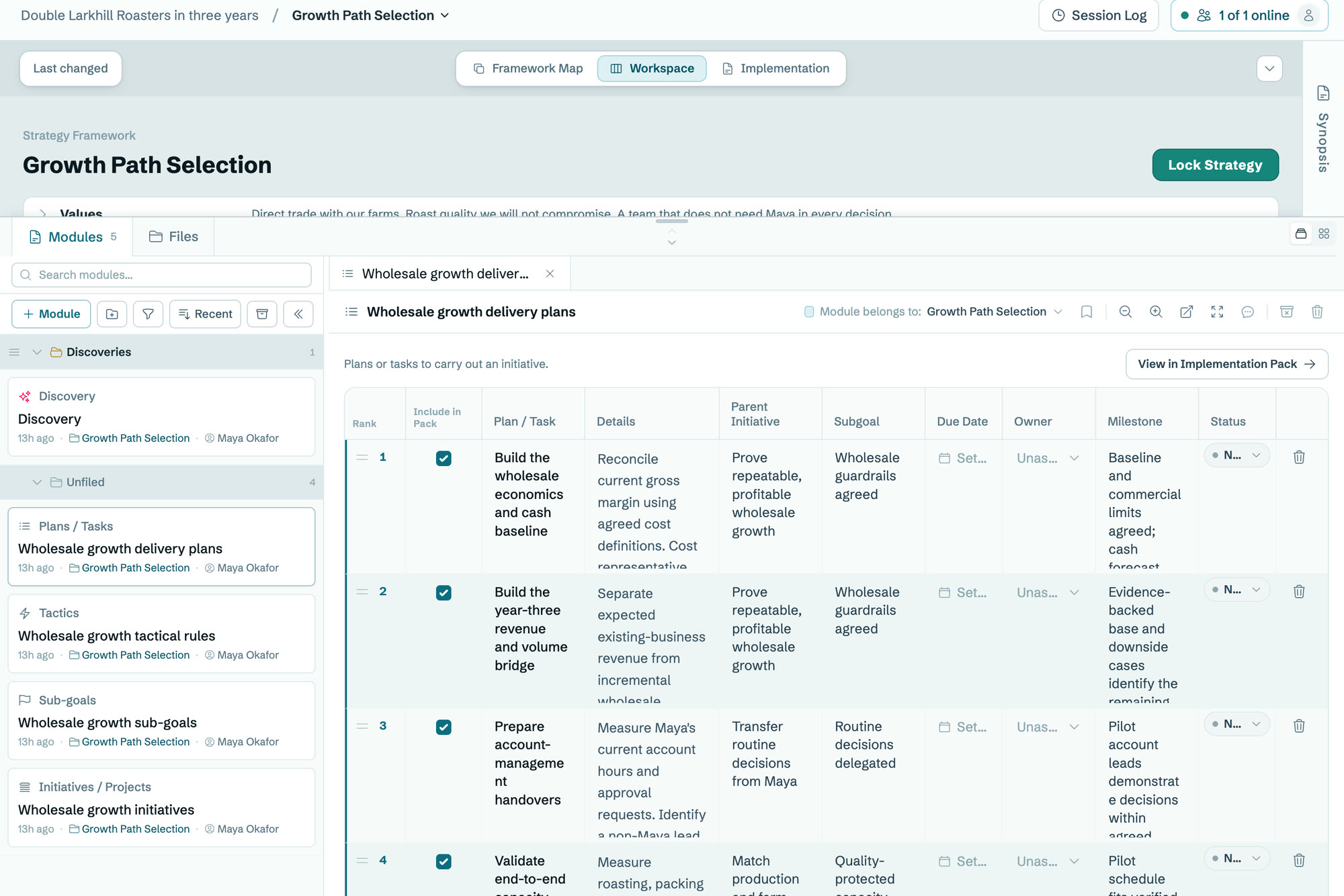
Everything starts with an endeavor: the goal you are working towards, such as doubling a business in three years. Wayframer opens each one with a short discovery, so the first draft starts from your real situation.
You break the endeavor into strategy frameworks on the framework map. Each framework has a workspace in four parts: the values you hold to, the aspiration you are reaching for, a diagnosis of what stands in the way, and the strategy alternatives.
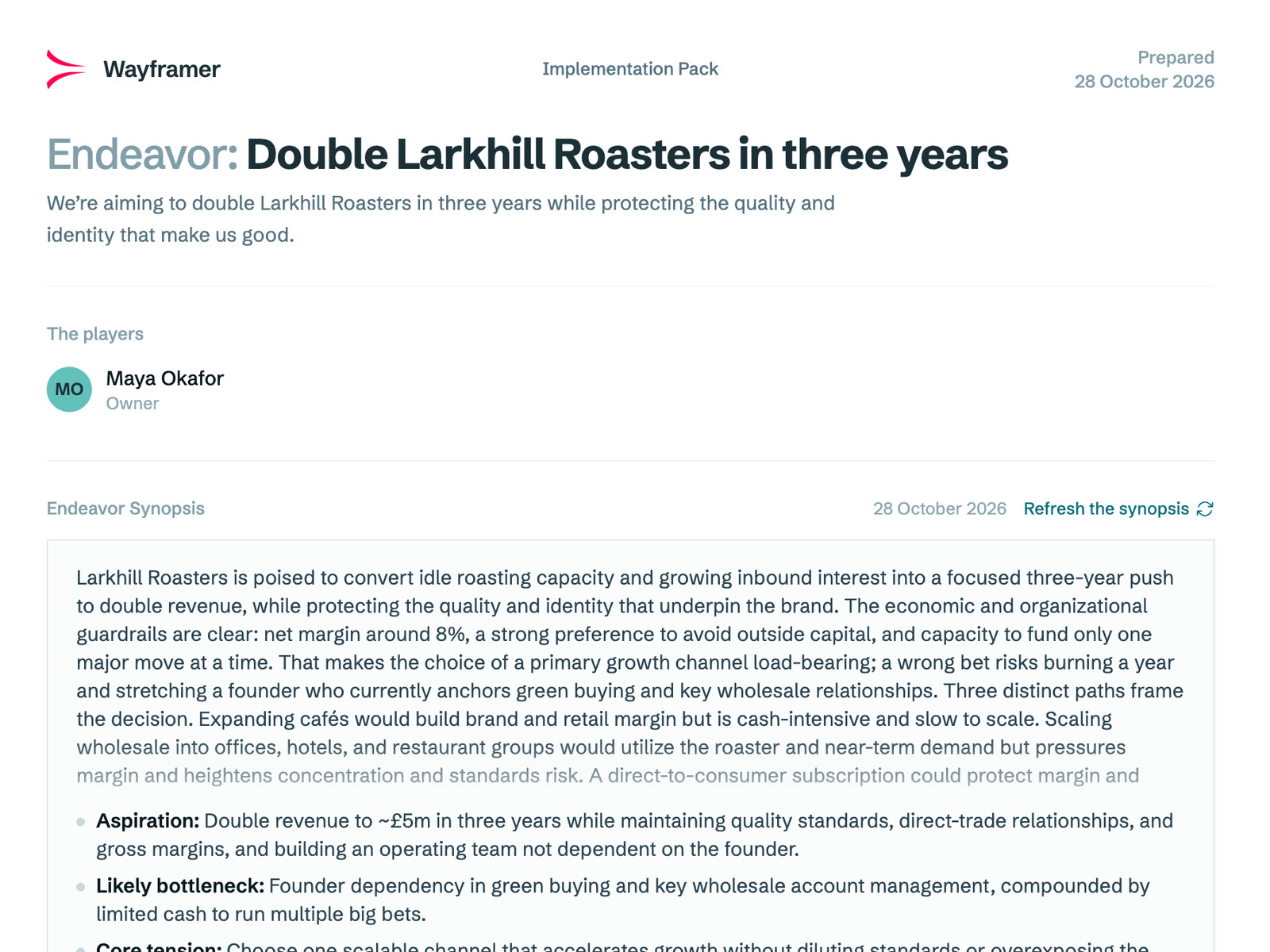
The alternatives sit side by side and are tested against the same criteria until one is left standing. Lock that strategy, and the Implementation Pack gathers the framework and the plans, tactics and initiatives that carry it out in one place.
Huxley works alongside you
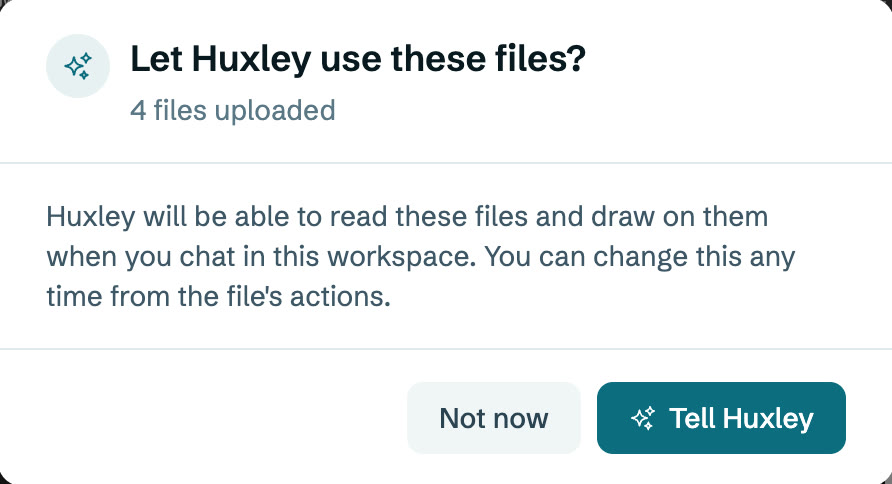
Huxley is the assistant built into Wayframer. Huxley sees the screen you are on, answers questions about your strategy and drafts the parts you ask for, asking first before reading your files or replacing anything you wrote.
Built for a team
Invite the people who shape the strategy. You see each other's changes as they happen, comment on any module, and the session log keeps a record of what changed and who changed it.
Questions
Do I need to read the book first?
No. Wayframer takes you through the method one step at a time. The book explains why each step works, and it is worth reading once you have started.
Who is Wayframer for?
Leaders and teams working in genuine complexity, where a fixed five-year plan rarely survives what happens next. Teams use it for a whole organisation’s strategy or for one hard decision.
Does Wayframer train AI on my work?
No. Huxley reads your strategy to help you with it, and Wayframer does not use your work to train AI models.
Who can see my strategy?
You, and the people you share an endeavor with. The security page explains how we protect your work.