The theory of constraints, applied to strategy
Every organisation has one constraint that sets the pace for everything else. Find it, and you know where effort will pay off and where it will be wasted.
Where the idea comes from
Eliyahu Goldratt introduced the theory of constraints in The Goal (1984), a novel about a plant manager trying to save a failing factory. Its central claim is simple. Any system that produces something has at least one constraint that limits its output, and the output of the whole system is set by that constraint. An hour lost at the constraint is an hour lost to the whole system. Goldratt put the other half bluntly: an hour saved anywhere else "is a mirage".
The five focusing steps
Goldratt turned the idea into a cycle of five steps:
- Identify the constraint.
- Exploit it: get the most out of it with what you already have.
- Subordinate everything else to it: run every other part at the pace the constraint can take.
- Elevate it: once it is fully used, invest to lift it.
- Repeat: when it lifts, something else becomes the constraint, so start again, and watch that old habits do not become the next one.
Constraints beyond the factory floor
Goldratt's later books carried the same thinking into projects, distribution and whole businesses. In strategy the constraint is rarely a machine. It is more often one of these:
- The market: too few customers want what you sell at the price you need.
- Money: the demand is there, but you cannot fund the stock or the staff to meet it.
- People and skills: one person or team that everything waits for.
- Policy: a rule, habit or measure that made sense once and now holds the system back. Goldratt argued that most constraints in organisations are of this kind.
A worked example
Larkhill Roasters, the fictional coffee roaster in these guides, can fund about 600 kg of green coffee a week. Its roaster could do 1,200 kg, packing and dispatch could handle 1,000 kg, and wholesale customers are asking for 900 kg. However hard the team works on roasting or packing, the business ships 600 kg, because that is all the coffee it can afford to buy.
A second roaster would add nothing. Faster payment from customers, or a supplier willing to give longer terms, would add a great deal. That is why the diagnosis guide names working capital as the bottleneck, and why each alternative in the example is judged on how it gets past it.
Finding your constraint
- Draw the path from what comes in to what customers receive, with each stage's capacity.
- Look for the stage where work queues up, or where everyone waits on one person, team or approval.
- Ask what would happen if each stage doubled. Where doubling changes nothing, you have not found the constraint.
- Look for a policy behind it. A rule about payment terms, sign-offs or batch sizes is often the real limit.
Constraints in Wayframer
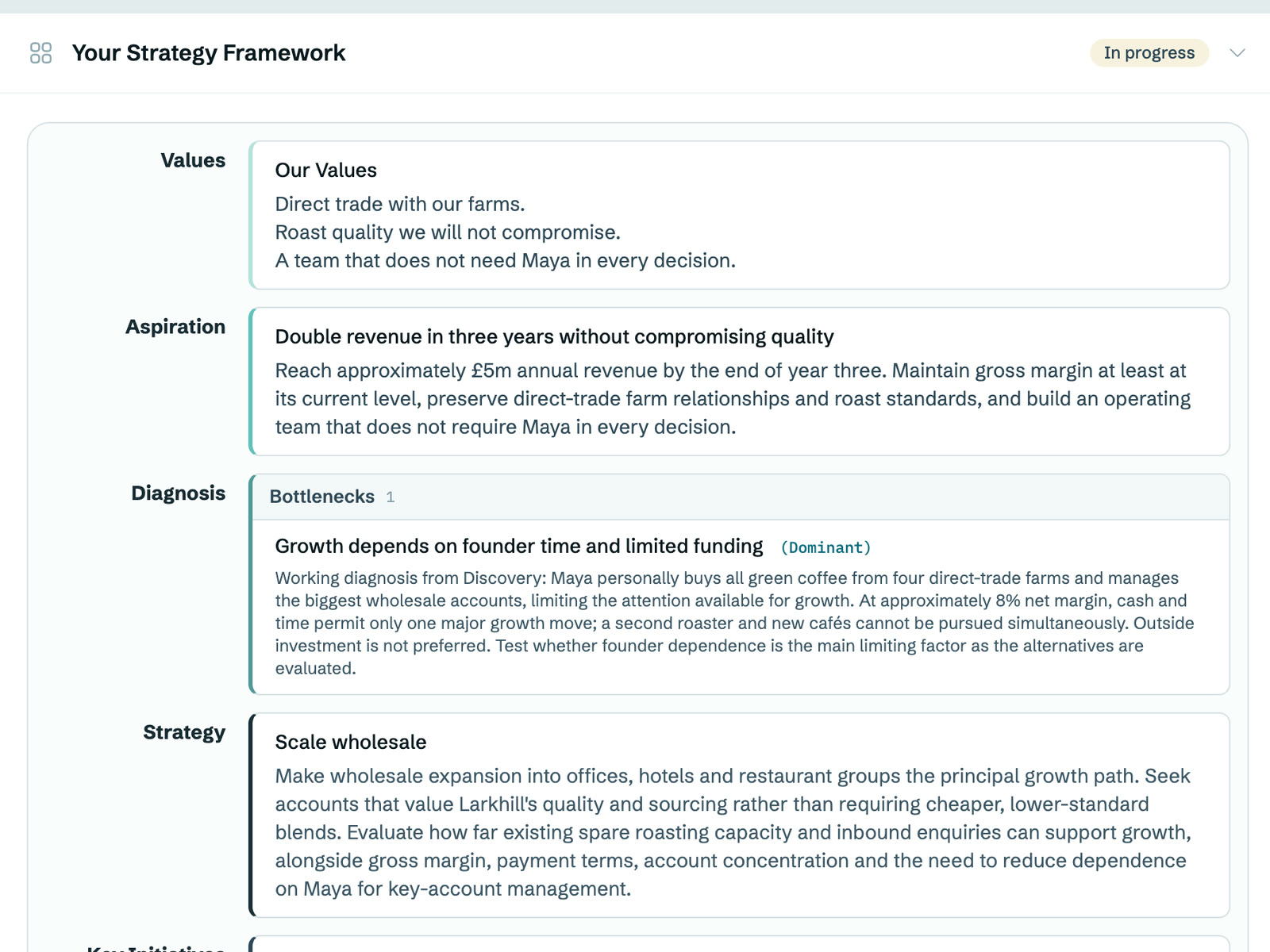
Wayframer's Diagnosis section asks for this: the main thing holding the endeavor back. Huxley can draft it from the discovery conversation and from files you allow, such as a capacity sheet or management accounts, and the likely bottleneck appears on the cover of the Implementation Pack. A fitness criterion in the Strategy Alternatives Matrix can then ask of every alternative whether it gets past that constraint.
Related guides
Strategic diagnosis. Say plainly what is in the way, and find the bottleneck that matters most.
From SWOT to strategy. Turn a SWOT analysis into real alternatives with the TOWS matrix, then test them and choose.
How to evaluate strategic options. Criteria and a step-by-step method for comparing ways forward and choosing one.
Questions
What is the theory of constraints?
A management approach developed by Eliyahu Goldratt and set out in The Goal (1984). It holds that every system has at least one constraint that limits its output, so improvement should start there.
What are the five focusing steps?
Identify the constraint, exploit it, subordinate everything else to it, elevate it, and repeat once it moves, without letting inertia become the next constraint.
How does the theory of constraints apply to strategy?
A strategy should start by naming the one thing that most limits progress, then choose the alternative that gets past it. Effort spent anywhere else changes little until the constraint moves.
What is a policy constraint?
A rule, habit or measure that limits what an organisation can achieve, such as payment terms, approval steps or targets that reward the wrong thing. Goldratt argued they are the most common kind.