From SWOT to strategy
A SWOT analysis describes where you stand, and stops there. Pairing its four quadrants turns that description into ways forward you can test and choose between.
What a SWOT is good for
A SWOT analysis sorts what you know into four lists: strengths and weaknesses inside the organisation, opportunities and threats outside it. It is quick, everyone understands it, and it gets the facts on the table, which makes it a good first hour for a strategy session.
Why so many SWOTs go nowhere
The trouble starts once the lists are written. A SWOT records the situation and makes no choice, so a team can fill all four boxes and still not know what to do on Monday. Three things usually go wrong:
- The lists grow too long. Twenty strengths are hard to act on. Three that matter are easy.
- The items are vague. "Strong brand" and "changing market" could describe anyone.
- Nothing connects the boxes. A strength only matters in relation to an opportunity it can seize or a threat it can blunt.
Pair the quadrants: the TOWS matrix
Heinz Weihrich proposed the TOWS matrix in 1982, in the journal Long Range Planning, to close that gap. It sets the internal factors against the external ones and asks a question in each of the four pairings:
- Strengths and opportunities: which strengths can we use to take this opportunity?
- Weaknesses and opportunities: which opportunity could help us overcome a weakness?
- Strengths and threats: which strengths can protect us from this threat?
- Weaknesses and threats: where are we exposed, and how do we limit the damage?
Each answer is a candidate way forward. The pairing of weaknesses and threats usually gives the defensive option, and it belongs on the list too, because holding steady is a real choice that the others should have to beat.
A worked example
Larkhill Roasters, the fictional coffee roaster in these guides, has a roastery with capacity to spare and little cash for stock or fit-outs. Independent cafés are asking to buy its beans, and green coffee prices are rising. Paired, those four lines give four ways forward:
- Strength and opportunity: scale wholesale to independent cafés.
- Weakness and opportunity: take deposits from cafés to fund green stock.
- Strength and threat: roast for other brands using their beans, so the price risk stays with them.
- Weakness and threat: hold steady and protect the cafés it already runs.
Some of these combine. Deposits from cafés could fund the push into wholesale, for example. Test each one on its own first, so you know what each part of a combination contributes.
From candidates to a choice
A TOWS matrix produces candidates. Choosing between them takes two more steps:
- Diagnose. Check the candidates against the main thing holding you back. If cash is the bottleneck, any option that needs cash up front has to say where it will come from. Strategic diagnosis covers this step.
- Test each one against the same criteria. Write down what any acceptable strategy must satisfy, judge every candidate against each criterion and rule out the ones that fail. How to evaluate strategic options sets out a method.
From SWOT to strategy in Wayframer
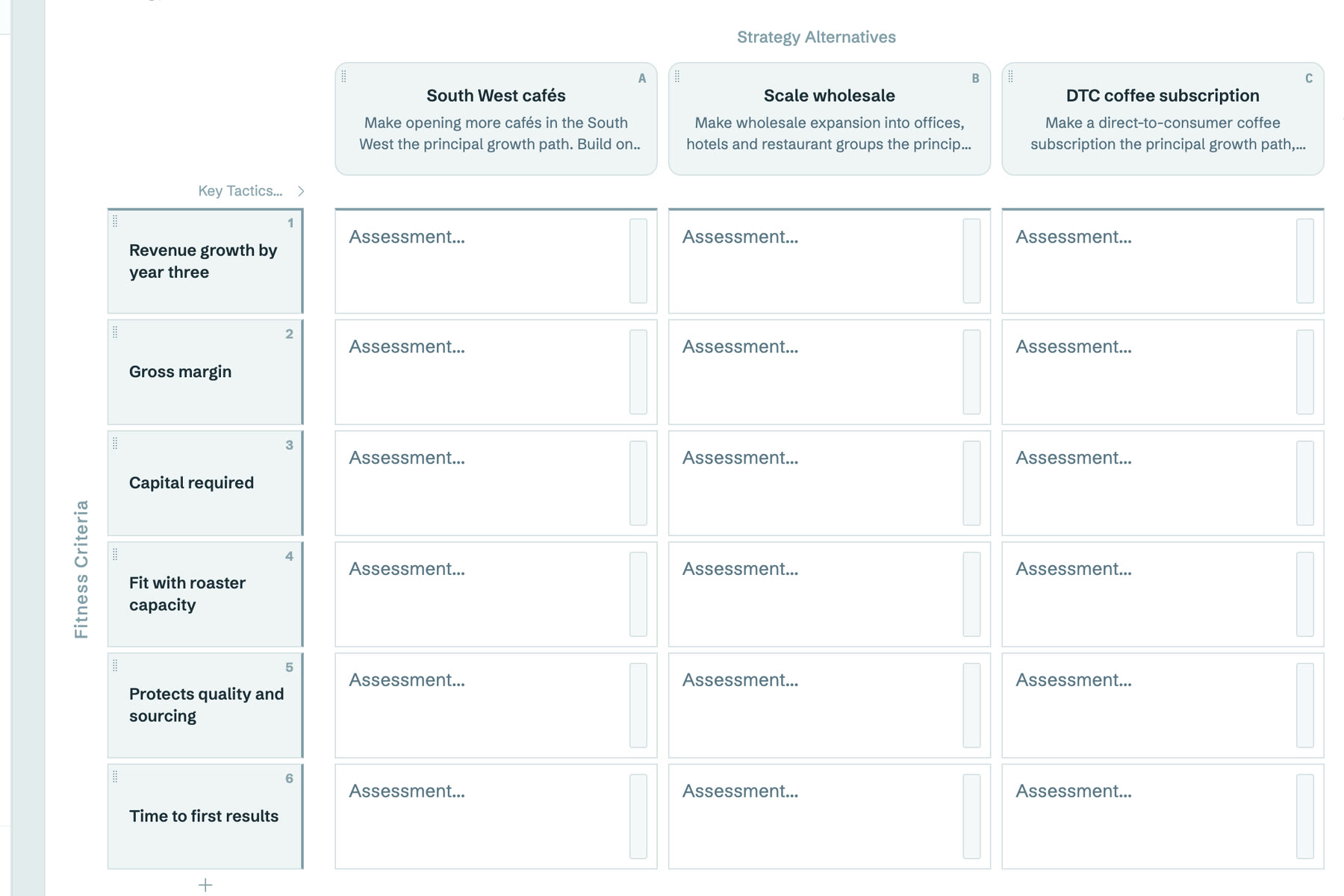
In Wayframer the facts a SWOT gathers go into the strategy framework: its values, its aspiration and a diagnosis of what is in the way, which Huxley can draft from the discovery conversation and the files you allow. Each candidate becomes an alternative in the Strategy Alternatives Matrix. Huxley assesses it against your fitness criteria when you ask, you decide which verdicts stand, and the alternatives that cannot fit are ruled out until one is left standing.
Related guides
Strategic diagnosis. Say plainly what is in the way, and find the bottleneck that matters most.
How to evaluate strategic options. Criteria and a step-by-step method for comparing ways forward and choosing one.
The Strategy Alternatives Matrix. Set the ways forward side by side and test each against the same fitness criteria.
Questions
How do you turn a SWOT analysis into a strategy?
Pair the quadrants. Ask how each strength could take an opportunity or blunt a threat, and how each weakness could be overcome or protected. Each answer is a candidate strategy, which you test against the same criteria before choosing one.
What is a TOWS matrix?
A tool Heinz Weihrich published in 1982 that sets the internal factors of a SWOT against the external ones. Its four pairings suggest strategies that use strengths to take opportunities, overcome weaknesses through opportunities, use strengths against threats, and limit exposure where weaknesses meet threats.
What is the difference between SWOT and TOWS?
They use the same four lists. A SWOT presents them as an assessment of the situation, and TOWS pairs them to generate strategic options.
What comes after a SWOT analysis?
A diagnosis of the main thing holding you back, a set of real alternatives, and a test of each alternative against the same criteria. The SWOT supplies the facts for all three.