The Strategy Alternatives Matrix
A Strategy Alternatives Matrix puts the ways forward side by side and tests each one against the same fitness criteria. Options that cannot fit are ruled out until one is left standing.
What a Strategy Alternatives Matrix is
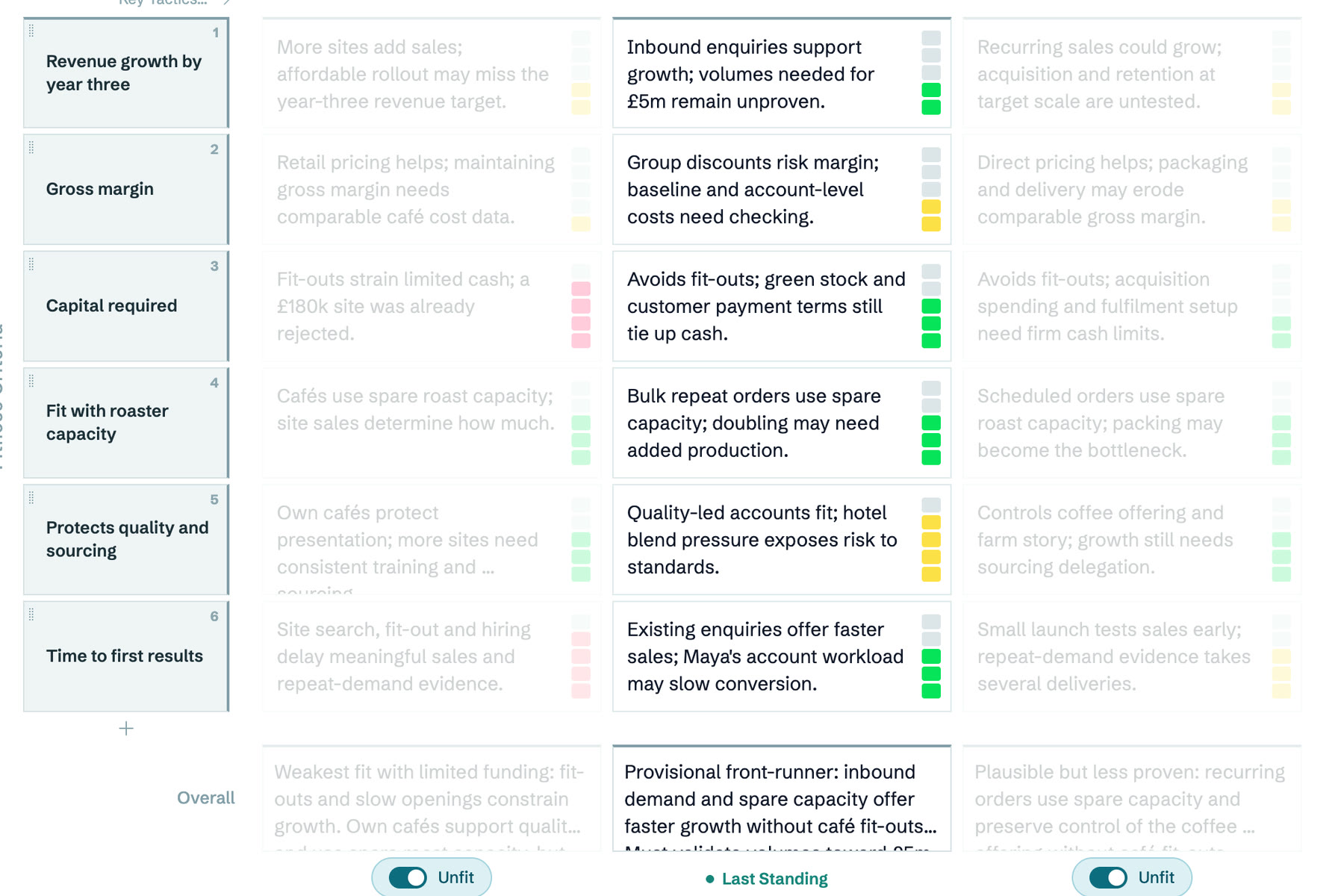
The Strategy Alternatives Matrix, or SAM, is the decision tool at the centre of the Emergent Approach, set out in Peter Compo's book The Emergent Approach to Strategy. Each column is a strategy alternative: a different way of reaching the same aspiration. Each row is a fitness criterion: something any strategy has to satisfy to work for this organisation. Each cell holds a verdict on how well that alternative meets that criterion, with the reason for it.
Reading across a row compares the alternatives on one criterion. Reading down a column shows everything that stands for and against one alternative.
How to build one
- Start from the aspiration and the diagnosis. The matrix compares ways of getting somewhere, so it needs a clear statement of where that is and what stands in the way. See strategic diagnosis.
- Write three or more real alternatives. Each should be a coherent way forward that someone in the room would argue for. Carrying on as now is often worth a column too.
- Choose the fitness criteria. Pick what decides success here, such as margin, capital required, fit with capacity, risk and time to results. Six or so is plenty.
- Assess every cell. Give each cell a verdict and write down why. The reasons are what the team will challenge, so they matter most.
- Rule out what cannot fit. An alternative that fails a criterion it must meet goes, however attractive it looks elsewhere.
- Lock the one left standing. The survivor becomes the strategy, with the reasoning that chose it kept beside it.
A worked example
Take a fictional coffee roaster that wants to double in three years. It has three alternatives: open more cafés in the South West, scale wholesale, or start a coffee subscription. Six fitness criteria, from gross margin to fit with roaster capacity, make eighteen cells.
Once every cell is assessed, the pattern is on the page before anyone has argued for a favourite. The cafés go first, because fit-outs strain limited cash and a £180k site was already rejected. Wholesale is left standing: inbound demand and spare capacity offer faster growth without café fit-outs.
What the matrix changes
Strategy meetings tend to favour the loudest advocate or the most senior person in the room. A matrix makes every alternative face the same tests, in writing, with the evidence for each verdict where everyone can see it. When conditions change, the team reopens the cells the change affects and checks whether a different alternative would now be left standing.
Related tools
A weighted decision matrix scores options against weighted criteria and adds up the totals. The Strategy Alternatives Matrix works with verdicts and reasons, and an option that fails a criterion it must meet is ruled out whatever else it scores. SWOT and TOWS analysis are ways to generate alternatives, and the matrix is where they are tested. StratNavApp has also published a guide to the matrix with a template, crediting the book.
For more on choosing criteria, see how to evaluate strategic options.
Building a matrix in Wayframer
Every strategy framework in Wayframer has a Strategy Alternatives section built on the matrix. Huxley, the built-in assistant, assesses each cell when you ask and writes down why, and you can change any verdict. Alternatives you rule out fade from the matrix, the survivor is marked Last Standing, and locking it carries the strategy into the Implementation Pack.
Related guides
How to evaluate strategic options. Criteria and a step-by-step method for comparing ways forward and choosing one.
Strategic diagnosis. Say plainly what is in the way, and find the bottleneck that matters most.
Strategy implementation plan. What to put in the plan that turns a chosen strategy into work.
Questions
What is a Strategy Alternatives Matrix?
A grid that sets strategy alternatives as columns against fitness criteria as rows. Each cell records how well an alternative meets a criterion and why. Alternatives that cannot meet the criteria are ruled out until one is left standing.
Where does the Strategy Alternatives Matrix come from?
It is part of the Emergent Approach, which Peter Compo set out in The Emergent Approach to Strategy: Adaptive Design & Execution (Business Expert Press, 2022).
How many alternatives should a strategy matrix have?
Three to five is usually enough. Fewer than three rarely shows a real choice, and more than five makes each cell harder to assess with care.
What are fitness criteria?
The conditions a strategy must meet to succeed in your situation, such as the capital it needs, the margin it earns or how well it fits your capacity. Every alternative is tested against the same criteria.