A strategy workshop agenda that ends in a decision
Plenty of strategy workshops end with a wall of sticky notes and a promise to follow up. This one-day agenda gives its time to the diagnosis and to testing real alternatives, so the group leaves having chosen.
Before the day
A workshop goes better when the facts arrive before the people do. A week ahead:
- Name the decision. Write down the question the day must answer, such as "how do we double revenue in three years?", and say who makes the final call.
- Send a short pre-read. The numbers that matter, what customers are saying and what has been tried before. Two pages is plenty.
- Draft the diagnosis. A first account of what is in the way gives the group something to argue with, which is faster than a blank page.
- Keep the group small. The people who will carry the strategy out and the person who decides. Four to eight works well.
The agenda
One day, from 09:00 to 17:00:
- 09:00 The question, and who decides. What the day must answer, who makes the final call, and the ground rules.
- 09:30 Values and aspiration. What the organisation will not compromise on, and the future it is working towards, stated so you would know when you got there.
- 10:30 Diagnosis. Test the draft. What is really in the way? Push past the symptoms to the bottleneck.
- 12:00 Lunch.
- 12:45 Three real alternatives. Genuinely different ways forward, each one something a sensible person would argue for. Include carrying on as you are.
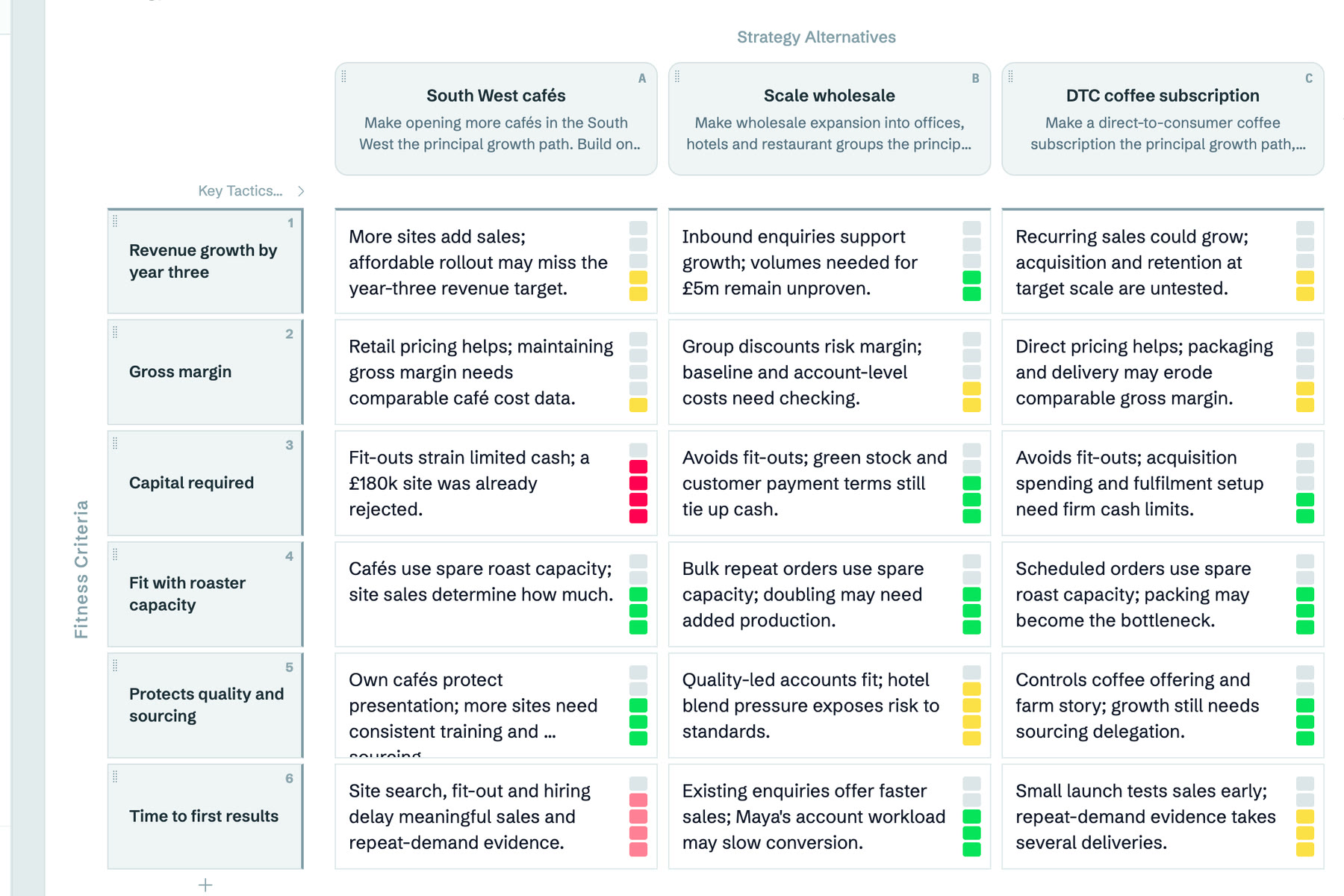
- 14:00 Test each against the fitness criteria. Agree what any acceptable strategy must satisfy, then judge every alternative against each criterion and say why.
- 15:30 Choose, and name what it rules out. Rule out what cannot fit, choose from what is left, and write down what the choice means you will stop doing or will not start.
- 16:15 First moves, owners and close. Two or three first initiatives, each with an owner and a date, and the date the group will review the choice.
Running each session
- Agree the problem before the solutions. Once a favourite idea is on the wall, people start describing the problem in a way that suits it.
- Write the criteria before you judge. Criteria agreed after the options are known tend to be chosen to favour one of them.
- Record the reasons. A verdict without a reason cannot be checked later, when the situation changes.
- Park what is out of scope. A visible list of parked items lets people stop arguing for them.
- Use a facilitator with no stake in the outcome. Someone has to keep time and protect the quieter voices, and it is hard to do while arguing a case.
After the workshop
Within a week, write the strategy down on one page: the aspiration, the diagnosis, the choice and what it rules out. How to write a strategy shows how. Turn the first moves into an implementation plan with owners and dates, and put the review in the calendar. A strategy chosen in a workshop will meet events nobody in the room foresaw, and the review is where it adapts to them.
Running the workshop in Wayframer
Wayframer can carry the day. Beforehand, the discovery conversation with Huxley and the files you allow give everyone the same starting point, and Huxley can draft the diagnosis for the group to test. On the day, the workspace holds the values, aspiration, diagnosis and the Strategy Alternatives Matrix, and everyone invited sees the matrix fill in as the group works. Afterwards, locking the strategy produces the Implementation Pack to send round, with the plans and initiatives that deliver it.
Related guides
The strategic planning process. Seven steps from a goal to a strategy the team can test and keep using.
How to evaluate strategic options. Criteria and a step-by-step method for comparing ways forward and choosing one.
How to write a strategy. What a written strategy needs, a strategy statement, and tests to run on the draft.
Questions
What should be on a strategy workshop agenda?
The decision the day must reach, values and aspiration, a diagnosis of what is in the way, real alternatives, a test of each against agreed criteria, the choice itself, and first moves with owners.
How long should a strategy workshop be?
One full day is enough for a small team with a clear question and a pre-read. Larger or more contested decisions often need two days, or two shorter sessions a week apart so people can gather evidence in between.
Who should attend a strategy workshop?
The people who will carry the strategy out and the person who makes the final call, ideally four to eight in all, with a facilitator who has no stake in the outcome.
What should come out of a strategy workshop?
A choice written down with what it rules out, two or three first initiatives with owners and dates, and a date to review the choice against what happens.